FLOOD RISK ASSESSMENT

Floods

As a naturally occurring phenomenon that can happen almost anywhere at any time, floods represent the highest regional threat in Northern Kentucky. At the most basic level, floods are defined as the accumulation of water over normally dry areas of land. Floods can be mild, leaving minor debris, and washing landscaping away, or severe wherein buildings and structures are damaged or destroyed. As an area with main watersheds, risk assessment is essential to prepare and mitigate the negative effects of flooding on the health of our populations.

Rivers
All Three Rivers District counties border or contain main watersheds including the Ohio, Kentucky, and Licking rivers, heightening flood risk.

Flood Risk Definitions: understanding flood zone terminology.

  • Regulatory Floodway – a channel of a river or other watercourse and the adjacent land areas that must be reserved in order to discharge the base flood without cumulatively increasing the water surface elevation more than a designated height. (FEMA)
  • Special Floodway – an area of special consideration as designated by FEMA in regard to flooding.
  • 1% Annual Chance of Flood Hazard – an area designated as having a 1 in 100 chance of a flood happening in any given year, meaning a flood could happen this year and again next year
  • .2% Annual Chance of Flood Hazard – an area designated as having a 1 in 500 chance or (500-year flood), in any given year.
  • River or Riverine Flooding – a high flow or overflow of water from a river or similar body of water, occurring over a period of time too long to be considered a flash flood.
  • Flash Floods – are quick-rising floods that usually occur as the result of heavy rains over a short period of time, often only several hours or even less, and can occur anytime throughout the year, but mostly during summer months.
  • Dam and Levee Failure Flooding – is potentially the worst flood event, occurring as a result of neglect, poor design, or structural damage caused by a major event such as an earthquake.
  • Watershed Area – is a land area that channels rainfall and snowmelt to creeks, streams, and rivers. 

Individual County Flood Risk and Vulnerabilities

Expand county detail content by clicking on the arrows to the left of the county name.

FLOOD RISK

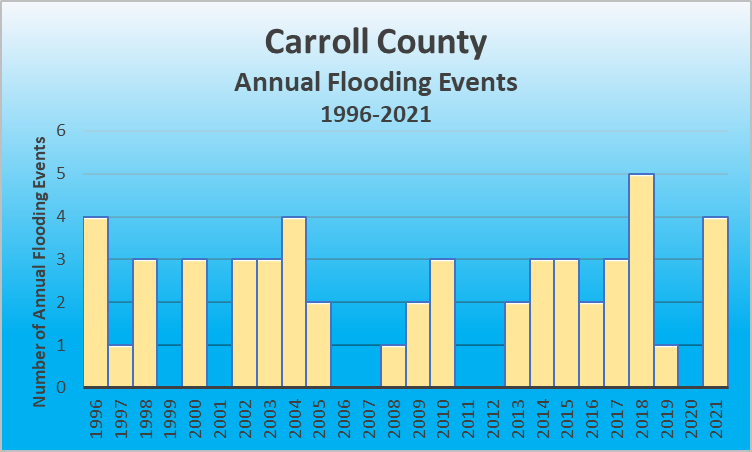
According to the 2020 Census, Carroll County covers 128.57 sq miles with a population of 10,810. As a county bordering the Ohio River and incorporating the Kentucky River within its boundaries, Carroll County is at high risk for flooding. This is evidenced by FEMA’s 4 federal disaster declarations for flooding since 1953.
Community Population Land Area (sq mi) Percent Land in Watershed Percent of Population in Watershed
City of Carrollton 3,938 1.2 59% 59%
City of Prestonville 161 .1 38% 38%
City of Sanders 238 .3 100% 100%
City of Worthville 185 .3 100% 100%
Unincorporated areas of Carroll County 5,996 134.1 51% 51%
Risk Profile/Vulnerabilities
Location(s) Areas near rivers, creeks, and stormwater drainage are most susceptible to flooding.
Number of events 2016-2021 15
Annual rate of occurrence 2.5
Probability of Future Events Highly Likely
Warning Time River flooding – 3 to 5 days Flash flooding – minutes to several hours
Potential Impacts Short-term impacts include those related to human life, health, and public safety including utility damages and outages, infrastructure damage (transportation and communication systems), structural damage, fire, damaged or destroyed critical facilities, and hazardous material releases. As a consequence of the short-term impacts, economic losses such as unemployment, decreased land values, and agribusiness as well as public safety issues due to contaminants and pollutants may also be experienced in the longer term.
Use the map below to see where your home/business lies in relation to watershed areas.
Flooding events January 1, 2016 – December 31, 2021
Location County/Zone St. Date Time T.Z. Type Mag Dth Inj PrD CrD
ENGLISH CARROLL CO. KY 08/01/2016 12:20 EST-5 Flash Flood 0 0 0.00K 0.00K
CARROLLTON CARROLL CO. KY 08/01/2016 12:20 EST-5 Flash Flood 0 0 0.00K 0.00K
EAGLE STATION CARROLL CO. KY 04/29/2017 08:00 EST-5 Flash Flood 0 0 0.00K 0.00K
PRESTONVILLE CARROLL CO. KY 05/20/2017 20:00 EST-5 Flash Flood 0 0 0.00K 0.00K
CARROLLTON CARROLL CO. KY 05/24/2017 18:30 EST-5 Flood 0 0 0.00K 0.00K
CARROLLTON CARROLL CO. KY 02/24/2018 20:28 EST-5 Flash Flood 0 0 0.00K 0.00K
CARROLLTON CARROLL CO. KY 09/09/2018 02:15 EST-5 Flood 0 0 0.00K 0.00K
WORTHVILLE CARROLL CO. KY 09/09/2018 02:15 EST-5 Flood 0 0 0.00K 0.00K
EAGLE STATION CARROLL CO. KY 09/09/2018 06:00 EST-5 Flood 0 0 0.00K 0.00K
SANDERS CARROLL CO. KY 09/09/2018 14:00 EST-5 Flood 0 0 0.00K 0.00K
CARROLL CO. CARROLL CO. KY 06/09/2019 20:43 EST-5 Flood 0 0 0.00K 0.00K
EAGLE STATION CARROLL CO. KY 02/28/2021 11:00 EST-5 Flood 0 0 0.00K 0.00K
SANDERS CARROLL CO. KY 02/28/2021 23:00 EST-5 Flood 0 0 6.00K 0.00K
SANDERS CARROLL CO. KY 03/01/2021 00:00 EST-5 Flood 0 0 0.00K 0.00K
CARROLLTON CARROLL CO. KY 06/18/2021 23:30 EST-5 Flood 0 0 0.00K 0.00K
For details on each flooding event, click here to go to the NOAA website for flooding events in Carroll County Kentucky.

FLOOD RISK

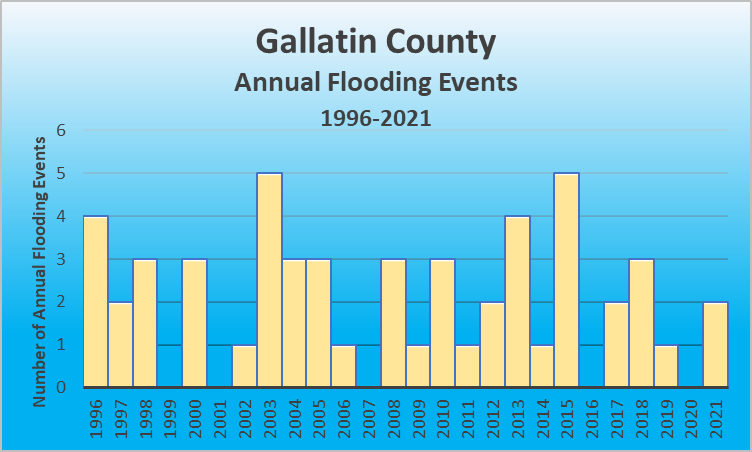
According to the 2020 Census, Gallatin County covers 101.23 sq miles with a population of 8,775. As a county bordering the Ohio River, Gallatin County is at high risk for flooding. This is evidenced by FEMA’s 2 federal disaster declarations for flooding since 1953.
Community Population Land Area (sq mi) Percent Land in Watershed % of Population in Watershed
City of Glencoe 251 .3 100% 100%
City of Sparta 230 2.4 100% 100%
City of Warsaw 1,884 1.03 Currently being reviewed  Currently being reviewed
Unincorporated Areas 6,297 21.5 21%% 21%
Risk Profile/Vulnerabilities
Location(s) Areas near rivers, creeks, and stormwater drainage are most susceptible to flooding.
Number of events 2016-2021 8
Annual rate of occurrence 1.3
Probability of Future Events Highly Likely
Warning Time River flooding – 3 to 5 days Flash flooding – minutes to several hours
Potential Impacts Short-term impacts include those related to human life, health, and public safety including utility damages and outages, infrastructure damage (transportation and communication systems), structural damage, fire, damaged or destroyed critical facilities, and hazardous material releases. As a consequence of the short-term impacts, economic losses such as unemployment, decreased land values, and agribusiness as well as public safety issues due to contaminants and pollutants may also be experienced in the longer term.
Use the map below to see where your home/business lies in relation to watershed areas.
Flooding events January 1, 2016 – December 31, 2021
Location County/Zone St. Date Time T.Z. Type Mag Dth Inj PrD CrD
ETHRIDGE GALLATIN CO. KY 05/24/2017 18:30 EST-5 Flash Flood 0 0 0.00K 0.00K
ETHRIDGE GALLATIN CO. KY 05/24/2017 18:45 EST-5 Flash Flood 0 0 0.00K 0.00K
SPARTA GALLATIN CO. KY 02/24/2018 20:35 EST-5 Flash Flood 0 0 0.00K 0.00K
SPARTA GALLATIN CO. KY 09/09/2018 02:30 EST-5 Flood 0 0 0.00K 0.00K
SPARTA GALLATIN CO. KY 09/09/2018 12:30 EST-5 Flood 0 0 0.00K 0.00K
WARSAW GALLATIN CO. KY 02/07/2019 16:12 EST-5 Flood 0 0 0.00K 0.00K
GLENCOE GALLATIN CO. KY 02/28/2021 11:00 EST-5 Flood 0 0 2.00K 0.00K
SUGAR BAY GALLATIN CO. KY 02/28/2021 11:00 EST-5 Flood 0 0 3.00K 0.00K
For details on each flooding event, click here to go to the NOAA website for flooding events in Gallatin County Kentucky.

FLOOD RISK

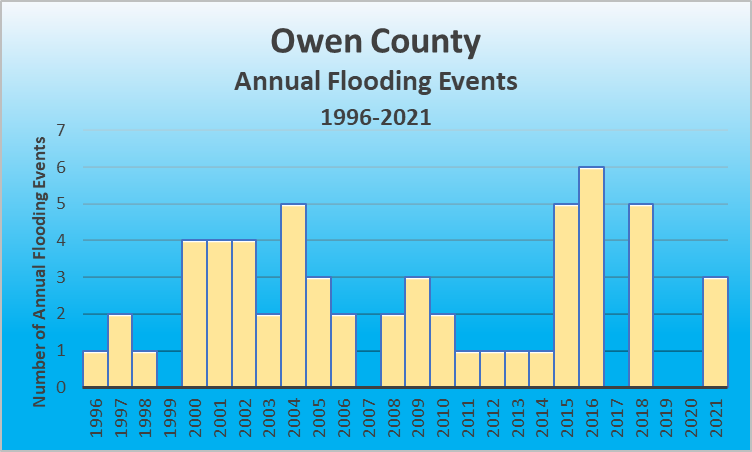
According to the 2020 Census, Owen County covers 101.23 sq miles and has a population of 11,294. As a county with communities bordering the Kentucky River, Owen County is at risk for flooding. This is evidenced by FEMA’s 5 federal disaster declarations for flooding since 1953.
Community Population Land Area (sq mi) Percent Land in Watershed % of Population in Watershed
City of Gratz 89 .3 100% 100%
City of Monterey 167 .3 100% 100%
City of Owenton 1,327 1.1 100% 100%
City of Sparta 230 2.4 100% 100%
Unincorporated Areas 9,258 352.1 100% 100%
Risk Profile/Vulnerabilities
Location(s) Areas near rivers, creeks, and stormwater drainage are most susceptible to flooding.
Number of events 2016-2021 14
Annual rate of occurrence 2.3
Probability of Future Events Highly Likely
Warning Time River flooding – 3 to 5 days Flash flooding – minutes to several hours
Potential Impacts Short-term impacts include those related to human life, health, and public safety including utility damages and outages, infrastructure damage (transportation and communication systems), structural damage, fire, damaged or destroyed critical facilities, and hazardous material releases. As a consequence of the short-term impacts, economic losses such as unemployment, decreased land values, and agribusiness as well as public safety issues due to contaminants and pollutants may also be experienced in the longer term.
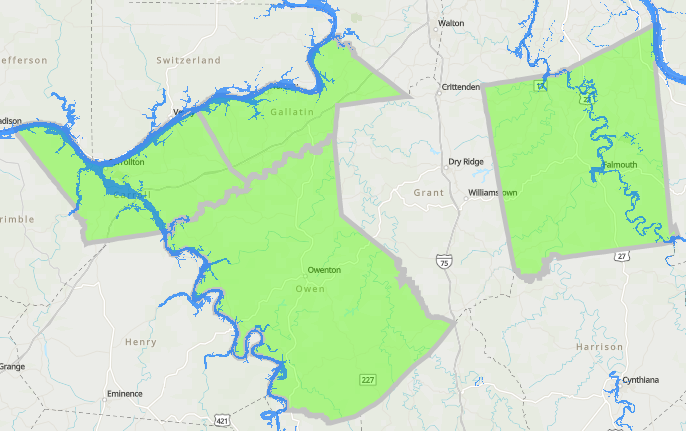
Use the map below to see where your home/business lies in relation to watershed areas.
Flooding events January 1, 2016 – December 31, 2021
Location County/Zone St. Date Time T.Z. Type Mag Dth Inj PrD CrD
TERESITA OWEN CO. KY 05/01/2016 15:40 EST-5 Flash Flood 1 0 50.00K 0.00K
CULL OWEN CO. KY 06/23/2016 16:25 EST-5 Flood 0 0 0.00K 0.00K
NEW OWEN CO. KY 06/23/2016 16:45 EST-5 Flash Flood 0 0 0.00K 0.00K
HARMONY OWEN CO. KY 06/23/2016 17:00 EST-5 Flash Flood 0 0 0.00K 0.00K
TERESITA OWEN CO. KY 06/23/2016 17:00 EST-5 Flash Flood 0 0 0.00K 0.00K
NATLEE OWEN CO. KY 06/23/2016 17:00 EST-5 Flash Flood 0 0 0.00K 0.00K
OWENTON OWEN CO. KY 04/03/2018 20:00 EST-5 Flash Flood 0 0 3.00K 0.00K
POPLAR GROVE OWEN CO. KY 05/22/2018 19:30 EST-5 Flood 0 0 0.50K 0.00K
MOXLEY OWEN CO. KY 09/09/2018 02:00 EST-5 Flood 0 0 0.00K 0.00K
MOXLEY OWEN CO. KY 09/09/2018 06:00 EST-5 Flood 0 0 0.00K 0.00K
SQUIRESVILLE OWEN CO. KY 09/24/2018 15:00 EST-5 Flood 0 0 0.00K 0.00K
OWENTON OWEN CO. KY 02/28/2021 11:00 EST-5 Flood 0 0 0.00K 0.00K
PERRY PARK OWEN CO. KY 03/04/2021 15:00 EST-5 Flood 1 0 0.00K 0.00K
NEW LIBERTY OWEN CO. KY 06/13/2021 16:00 EST-5 Flash Flood 0 0 30.00K 0.00K
For details on each flooding event, click here to go to the NOAA website for flooding events in Owen County Kentucky.

FLOOD RISK

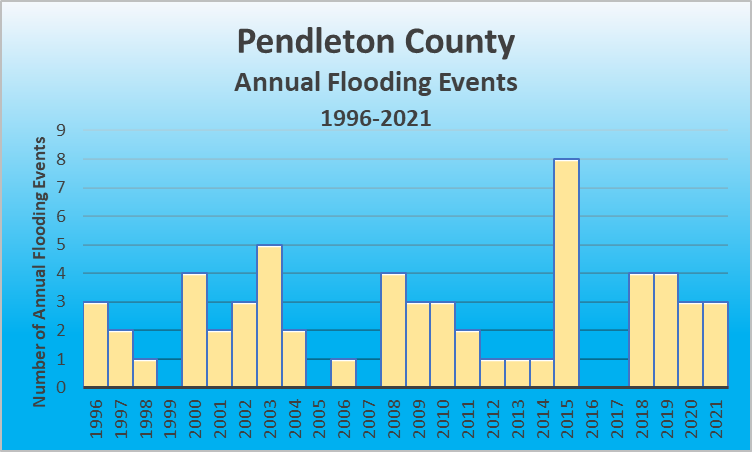
According to the 2020 Census, Pendleton County covers 277.16 sq miles and has a population of 14,607. As a county with communities containing the Licking River, and bordering the Ohio River, Pendleton County is at risk for flooding. This is evidenced by FEMA’s 2 federal disaster declarations for flooding since 1953.
Community Population Land Area (sq mi) Percent Land in Watershed % of Population in Watershed
City of Butler 612 .2 100% 100%
City of Falmouth 2,169 1 50% 50%
Risk Profile/Vulnerabilities
Location(s) Areas near rivers, creeks, and stormwater drainage are most susceptible to flooding.
Number of events 2016-2021 14
Annual rate of occurrence 2.3
Probability of Future Events Highly Likely
Warning Time River flooding – 3 to 5 days Flash flooding – minutes to several hours
Potential Impacts Short-term impacts include those related to human life, health, and public safety including utility damages and outages, infrastructure damage (transportation and communication systems), structural damage, fire, damaged or destroyed critical facilities, and hazardous material releases. As a consequence of the short-term impacts, economic losses such as unemployment, decreased land values, and agribusiness as well as public safety issues due to contaminants and pollutants may also be experienced in the longer term.
Use the map below to see where your home/business lies in relation to watershed areas.
Flooding events January 1, 2016 – December 31, 2021
Location County/Zone St. Date Time T.Z. Type Mag Dth Inj PrD CrD
FALMOUTH PENDLETON CO. KY 02/22/2018 08:42 EST-5 Flood 0 0 0.00K 0.00K
MERIDIAN PENDLETON CO. KY 09/08/2018 21:15 EST-5 Flood 0 0 0.00K 0.00K
FOUR OAKS PENDLETON CO. KY 09/09/2018 02:45 EST-5 Flood 0 0 0.00K 0.00K
FALMOUTH PENDLETON CO. KY 09/09/2018 06:00 EST-5 Flood 0 0 0.00K 0.00K
KNOXVILLE PENDLETON CO. KY 02/06/2019 13:28 EST-5 Flood 0 0 0.00K 0.00K
DE MOSSVILLE PENDLETON CO. KY 02/06/2019 13:28 EST-5 Flood 0 0 0.00K 0.00K
LYNN PENDLETON CO. KY 02/06/2019 13:28 EST-5 Flood 0 0 0.00K 0.00K
PENDLETON CO. PENDLETON CO. KY 06/17/2019 21:00 EST-5 Flash Flood 0 0 25.00K 0.00K
CALDWELL PENDLETON CO. KY 05/24/2020 16:45 EST-5 Flood 0 0 0.00K 0.00K
MERIDIAN PENDLETON CO. KY 05/24/2020 17:00 EST-5 Flood 0 0 0.00K 0.00K
FOUR OAKS PENDLETON CO. KY 05/25/2020 14:30 EST-5 Flood 0 0 0.00K 0.00K
HAYES PENDLETON CO. KY 02/28/2021 11:00 EST-5 Flood 0 0 0.00K 0.00K
GREENWOOD PENDLETON CO. KY 04/28/2021 17:30 EST-5 Flood 0 0 0.00K 0.00K
BUTLER PENDLETON CO. KY 04/28/2021 17:30 EST-5 Flood 0 0 0.00K 0.00K
For details on each flooding event, click here to go to the NOAA website for flooding events in Pendleton County Kentucky.

Resources

Know your Risks for Floods

An important part of preparing for a flood includes knowing your risk. You can use the map(s) above to see where your home or business lies in regard to flood zones. Knowing this can help you to know what further actions you should take such as purchasing flood insurance and preparing in advance for a flood. You can also visit FEMA’s Flood Map Service Center and enter a specific address to search.

Purchase Flood Insurance

Most homeowners’ insurance policies do not cover damage as a result of flooding. Specific flood insurance policies are available to cover those damages. If you rent rather than own, you can still get flood insurance to cover the contents of your residence in the event of a flood.

The National Flood Insurance Program is available at more than 50 insurance companies across the nation and NFIP Direct. Please note, that it can take up to 30 days for a flood insurance policy to go into effect so do not delay.

Make a Plan

Make a plan for your household including your pets so everyone knows what to do, where to go, and what you will need to protect yourselves from flooding.

  1. Be familiar with evacuation routes and alternates in the event a normal route is cut off from flooding.
  2. Develop personal shelter plans including where you will shelter if you must leave your home, how you will get there, and what to take.
  3. Be alert to the need for flash flood response. You can sign up for local emergency alert system(s) for advanced/timely notice. (Remember, flash floods happen very quickly, so time of is of the essence.)
  4. Gather enough supplies and water for several days in case you must leave immediately or if services are cut off in your area for an extended period of time.
  5. Purchase a NOAA-qualified battery-operated weather radio to receive timely and current weather alerts in your area.
Flood Risk Assessment - Emergency Evaucuation Image

To sign up for the local emergency alert system(s) in your area, click on the county below, or link to the local emergency management department Facebook page of your county.

HAZARDS

Do’s

 
  • Heed warnings right away, don’t wait and see
  • Find safe shelter right away
  • Use your NOAA weather radio to stay up to date on current recommendations and instructions for flooding
  • Listen to local emergency response teams for appropriate action to take
  • Evacuate immediately if told to do so
  • Move to higher ground or a higher floor if trapped
  • Stay off bridges over fast-moving water as they can be quickly swept away without warning
  • Stay inside your car if it is trapped in rapidly moving water. Get on the roof if water is rising inside the car.
  • Get to the highest level if trapped in a building. Only get on the roof if necessary and once there signal for help.

Dont’s

  • Do not drive around barricades, they are there for your protection
  • Do not drive, walk, or swim through flood waters (Turn around. Don’t Drown!) Just six inches of moving water can sweep you off your feet, and twelve inches can sweep your vehicle away.
  • Do not climb into a closed attic to avoid getting trapped by rising floodwater.

Download FEMA’s How to Stay Safe During a Flood and take an active role in your safety!

Our homes are our lifeline to stability and connectedness with the world. As a result, we can be left feeling vulnerable and anxious when access has been disrupted. It is only natural to want to return home as quickly as possible after a flood or other natural disaster but waiting until it is safe is vital for your safety and health.

  • Return home only after authorities have indicated it is safe
  • Avoid driving after a flood, except in emergencies. (Roads may have washed away or debris may litter roadways and create travel hazards)
  • Wear appropriate personal protective equipment when doing clean-up. Heavy duty gloves, protective clothing, and boots, and use appropriate face coverings/masks if cleaning mold or other debris.
  • Children should not assist with cleanup work.
  • Persons with COPD/Asthma or other lung conditions and suppressed immune systems should not be exposed to mold that is visible or can be smelled.
  • Be aware of snakes and other animals that may have entered your house while the waters were high.
  • Be aware of the risk of electrocution. Do not touch any electrical equipment if it is wet or if you are in standing water. Turn off the electricity to prevent shock if it is safe to do so.
  • Avoid wading in flood water. Flood water can be contaminated with harmful debris and or downed power lines that can electrically charge the water.
  • Use a generator or other gasoline-powered machine ONLY outdoors and away from windows.

Conclusion

It’s no surprise floods put many assets at risk. First and foremost are those impacting human life through injuries, and loss of loved ones. Second, are our many personal property and physical assets which we use in our daily lives. Third are the infrastructure assets which are the foundation upon which our communities thrive and are essential for sustaining life as we know it. Loss of these assets without the ability to recover puts families and communities at severe risk of collapse.

Facebook
Twitter
LinkedIn